
If you’ve been wondering what NDIS funds can be used for and what the NDIS covers under the new rules, you’re not alone. The 2024 NDIS changes brought significant updates, specifically focusing on NDIS Supports Definitions, Carve Outs and Exclusions (items and services that can no longer be funded).
This guide aims to clarify what these specific changes mean for participants and providers. We will help you understand and use the updated boundaries of NDIS funding effectively based on official docs.
NDIS Supports And The Recent Changes
NDIS funding rules changed significantly on October 3, 2024, bringing a stricter focus on what can be funded. Let’s compare how NDIS support definitions have evolved, and clarify the key terms you’ll encounter throughout this guide.
Pre-2024 Context
Before these changes, NDIS provided broader flexibility in funding, allowing for a wide range of supports that sometimes went beyond strict disability needs. Items related to general well-being, household management, and community participation were commonly covered under the scheme.
Post-October 3, 2024 Changes
Starting October 3, 2024, the definitions of “NDIS supports” have become narrower, reducing the scope of what is fundable. These changes remove some services and goods that participants previously relied on, focusing only on those directly tied to disability needs. This has led to concerns among participants about the potential loss of previously available supports and how these exclusions could impact daily living and overall well-being.
Important Terms in This Guide
- Supports Definitions: The criteria and descriptions that determine what types of goods and services qualify as NDIS supports.
- Supports Exclusions: A list of goods, services, or categories that are now entirely excluded from NDIS funding.
- Carve Outs: Specific items or services that have been explicitly removed from eligibility for NDIS funding. Carve-outs define what the NDIS will no longer fund.
Now, we will go deeper into the details to simplify everything for you. Ready?

How Do The NDIS Determine What Can Be Funded?
By zeroing in on supports that genuinely enhance independence and well-being, the NDIS aims to sustain its funding and help participants at the same time. But how do they decide what qualifies for funding? Let’s break down the criteria.
The Reasonable and Necessary Test
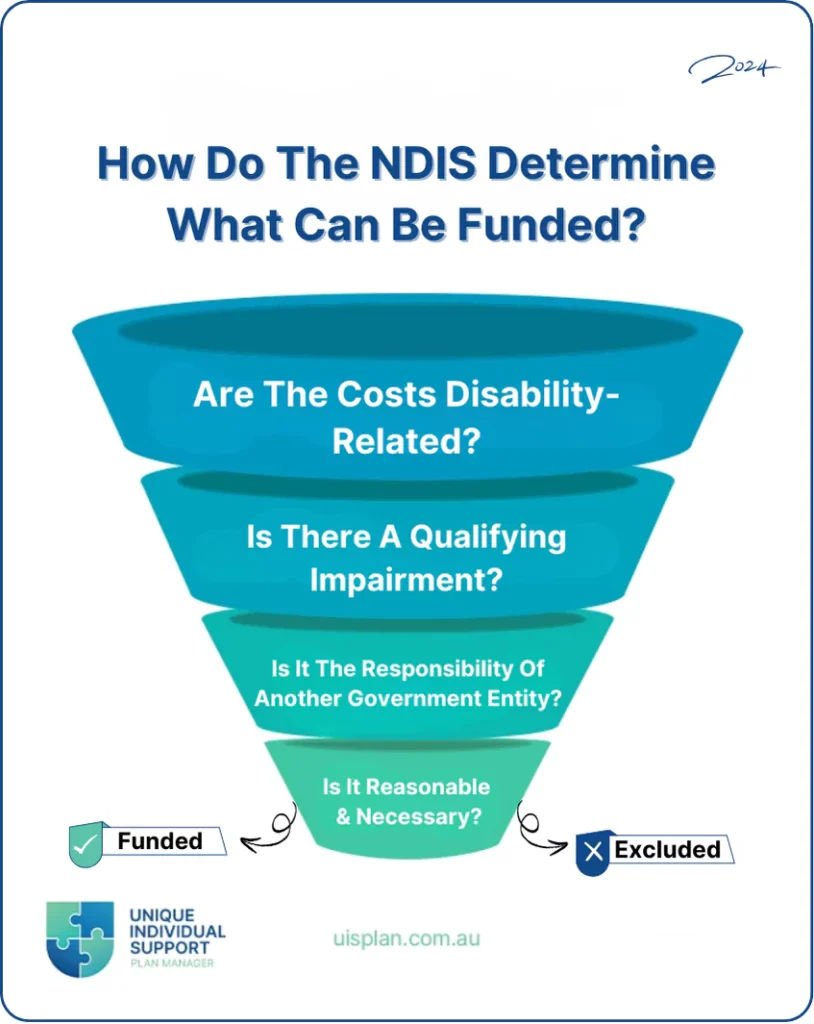
The NDIS uses a systematic approach to decide whether a support qualifies for funding. The decision-making process involves several stages, similar to a funnel that filters out what doesn’t meet the specific criteria. Here are the main steps they consider:
- Are The Costs Disability-Related? The support must clearly address a specific need related to the participant’s disability.
- Does The Support Address A Disability Need? The support must directly relate to the participant’s disability and be necessary for their well-being.
- Is It The Responsibility Of Another Government Entity (Mainstream Services)? The NDIS won’t cover supports that should fall under other public services, such as Healthcare, Social Services, Or Education.
- Is It Reasonable & Necessary? Supports must pass the reasonable and necessary test, meaning they should be cost-effective, directly beneficial, and essential to the participant’s quality of life.
Examples of Funded NDIS Supports
To give you a clearer idea, here are some examples of what the NDIS might fund:
- Assistive Technology like wheelchairs or communication devices, if they are essential for independence.
- Therapy Services such as speech or occupational therapy that help you develop new skills or manage your disability better.
- Support Workers who assist with daily living activities, such as personal care or helping with household tasks, when these tasks cannot be managed independently due to the participant’s disability.

2024 Exclusions | What NDIS Funds Can’t Be Used For
There are now 15 categories of goods and services explicitly excluded from NDIS funding. Some of these categories represent types of support that participants could previously access but now fall outside of what NDIS will cover, significantly narrowing the scope. Below, we present each exclusion category, highlighting what items/costs are now out.
Related: Is The NDIS Cutting Funding?
NDIS Exclusion 1: Day-to-Day Living Costs
NDIS does not cover accommodation-related expenses like rent, mortgage payments, utilities, or general household items. The exclusion extends to standard household appliances, such as fridges, dishwashers, and basic furniture, which are non-essential for disability support.

Specific Items Exclusions
- Rent, mortgage repayments, utilities (e.g., gas, water, electricity).
- Household appliances (e.g., washing machines, standard kitchen utensils).
The NDIS Point Of View
NDIS aims to direct funding exclusively towards disability-specific supports. The exclusion of household expenses ensures that the scheme is focused on its primary purpose—supporting direct disability needs.
Participants Concerns
Some participants are concerned about how the new exclusions may be interpreted in practical terms, particularly regarding items that might serve both household and disability functions, such as specialized kitchen equipment. They worry that important modifications could be denied if they fall under general household categorization.
NDIS Exclusion 2: Food and Groceries
Under the updated rules, NDIS funds cannot cover general food and grocery expenses. This means participants cannot claim everyday grocery shopping, takeaway meals, or general food delivery services. Only food that specifically meets a disability-related dietary need, such as a prescribed meal plan, may still be considered.

Specific Items Exclusions
- Groceries: General food shopping, including everyday food items and household consumables, is excluded.
- Takeaway and Food Delivery: Meals from fast food outlets and food delivery services are not covered unless there is a clear medical need tied to the participant’s disability.
Why These Exclusions Exist
The NDIA Sees everyday food and grocery costs as part of normal living expenses, which participants need to manage separately away from their NDIS funding.
Participants Concerns
Some participants with specific dietary needs worry that these exclusions might make it harder for them to afford meals that meet their medical requirements. They are concerned that without NDIS support, accessing food that addresses their dietary needs could become financially burdensome.
NDIS Exclusion 3: Medical Costs Exclusions
The NDIS does not cover a wide range of medical-related expenses. These exclusions include costs for diagnosis, clinical treatment, pharmaceuticals, and various health services that should be funded by the health system. The NDIS aims to provide disability-specific supports, while mainstream health care handles medical needs.

Specific Items Exclusions
A. Health Conditions and Clinical Treatments:
The NDIS does not cover the costs of diagnosing or treating health conditions, whether acute or chronic. This includes any early intervention, clinical treatment, or dental care. For example, if a participant needs treatment for a heart condition or a dental procedure, they need to use regular health services.
B. Diagnostic Services:
Participants cannot use NDIS funds for health assessments, screenings, or any diagnostic services. Tests and scans that a doctor orders, such as blood tests or X-rays, are not covered by NDIS.
C. Recovery-Oriented Services:
The NDIS does not cover short-term therapies aimed at recovering after a medical or surgical event. This includes rehabilitation services or treatments intended to improve someone’s condition after surgery or acute illness. For example, if a participant needs rehabilitation after a knee surgery, these services fall under the health system, not NDIS.
D. Pharmaceuticals and Supplements:
The NDIS does not fund medications, whether prescribed or over-the-counter. This also includes vaccines, biological medicines, vitamins, weight loss products, sport supplements, homeopathic medicines, and sunscreens. Participants need to manage these expenses through the regular health system.
E. Medical Equipment and Aids Unrelated To Disability
The NDIS will not cover equipment prescribed as part of a medical treatment unrelated to the participant’s disability. For instance, if a participant receives a knee brace after a sports injury, they must pay for it through their healthcare provider.
F. Surgical Procedures:
The NDIS does not fund any surgical services or procedures, including surgeries for aids or equipment.
G. Hospital Services:
Acute, subacute, emergency, or outpatient services delivered through hospitals are also excluded. If participants need emergency room care or any hospital treatment, these costs fall under mainstream health services.
H. Optical and Hearing Supports:
The NDIS will not cover prescription glasses, contact lenses, or hearing services that are already provided through the Hearing Services Program. Any surgical services for hearing also fall outside the NDIS scope.
I. Nursing and Health Services:
Nursing services related to treating a health event are not funded by NDIS. This includes ambulance services, health transport, and hospital-at-home services. Participants must access these services through mainstream health care.
J. Other Health-Related Services:
Health retreats, sleep consultants, and maternal and newborn follow-up care are also excluded. These services are part of the broader health system and are not covered by the NDIS.
K. Palliative and Sub-Acute Care:
The NDIS does not fund palliative care or sub-acute care provided at home or in a clinical setting. The health system manages these services, though NDIS will continue to provide disability-related supports at the same time if required.
The NDIA Rationale
The NDIS focuses on disability-specific supports that help participants live independently and manage everyday activities. Medical costs, treatments, and health services fall under the mainstream health system’s responsibility. By maintaining this division, the NDIS can ensure that funding is used specifically for supports that address disability, while the health system handles broader medical needs.
Participants Concerns
Participants often find the separation between health and disability supports confusing. Many struggle to understand why NDIS cannot fund medical equipment or services that seem closely tied to their disabilities.
For example, someone with both a disability and a chronic health condition may need a piece of medical equipment to manage their overall health, yet cannot use NDIS funding if it falls under a medical classification. This creates frustration and gaps in care, especially when mainstream health services cannot promptly meet those needs. Participants feel the need for better coordination between the health system and NDIS to avoid falling through these gaps.
NDIS Exclusion 4: Treatments Not Backed By Evidence and Research
NDIS no longer covers many health and wellness-related services, particularly those not based on strong medical evidence. Treatments like alternative therapies, wellness coaching, and complementary medicine are clearly out of NDIS funding. This also applies to general health treatments that do not directly address a participant’s disability.

Specific Items Exclusions
- Complementary and Alternative Therapies: NDIS funding does not cover therapies like reiki, aromatherapy, crystal therapy, tarot card reading, or other alternative treatments that lack sufficient evidence. This also includes wellness practices like yoga therapy, sound therapy, and other forms of non-medical interventions.
- General Health Services: Treatments related to the diagnosis or clinical treatment of general health conditions are excluded. This includes acute hospital services, pharmaceuticals (both prescription and non-prescription), palliative care, and any services provided through public or private hospitals. Equipment like a knee brace provided after a sports injury, which is unrelated to a disability, also falls outside of NDIS coverage.
- Wellness and Lifestyle Coaching: Life coaching, career coaching, and wellness coaching are not covered unless directly tied to managing a disability. Programs focused on general well-being or personal growth, such as hypnotherapy or somatic therapy, are also excluded.
Why These Changes Exist
The NDIS rationale is to ensure that funds go toward evidence-based and disability-focused supports. They believe complementary therapies and general health treatments often do not have proven benefits for managing disabilities.
Participants Concerns
Participants who used alternative therapies, such as reiki or aromatherapy, for pain management or relaxation now feel they have fewer options to manage their symptoms. They worry about the potential reduction in quality of life without access to these therapies.
NDIS Exclusion 5: Finance and Payments Related Costs
The new NDIS rules exclude a range of financial and payment-related costs. You can not use NDIS funding to pay for insurance, legal fees, or business-related costs.

Specific Items Exclusions
- Insurance Costs: Health insurance, car insurance, travel insurance, and life insurance are no longer covered.
- Financial Costs: You can’t use NDIS funds for fines, penalties, political donations, or child support payments. It also excludes superannuation contributions (money for retirement) and fringe benefits for contractors (extra perks like discounts or allowances).
- Business Costs: You can’t use NDIS funds for bookkeeping, accounting services, or repaying loans related to your business.
The NDIS Point Of View
NDIS aims to use its funds only for disability-related supports, not for general financial responsibilities like insurance or business costs. The NDIA considers insurance, financial fees, and business costs as personal financial responsibilities.
NDIS Exclusion 6: Travel and Transport Related Costs
The updated guidelines specify that many travel and transport-related expenses cannot be covered by NDIS. This includes personal travel costs, such as holidays, general vehicle purchases, and unrelated vehicle expenses. NDIS only funds transport when it directly relates to the participant’s disability support needs.

Specific Items Exclusions
- Holiday Travel Costs: Cruises, holiday packages, holiday accommodation, and airfares (both interstate and overseas). Costs related to passports, visas, activities, and meals included in travel packages are also not covered.
- Vehicle Purchases: Any type of motor vehicles, including motorbikes, watercraft, all-terrain vehicles, standard bicycles, scooters, and other recreational vehicles.
- Non-Legal Modifications: Vehicles, devices, or modifications that do not meet legal standards for use in the relevant State or Territory.
- Repairs and Maintenance: Mechanical repairs (except those specifically related to NDIS-funded vehicle modifications) and costs for automotive tools.
- Vehicle Registration: NDIS will not cover vehicle registration fees.
- Personal Mobility Devices: Devices such as e-scooters, electric bikes, and skateboards fall outside NDIS funding.
- Transport for Children: Costs associated with transporting children as part of their general care and support from families or carers.
- Fuel Costs: NDIS does not cover petrol, diesel, or gas expenses.
Why These Exclusions Exist
The NDIS allocates funding strictly for disability-related needs, particularly focusing on transport that directly supports access to disability services. General travel and recreational vehicle costs do not meet this criterion in the eyes of the latest legislation.
Participants Concerns
Participants express concerns about how these exclusions may limit their independence, particularly for those who rely on specially modified vehicles. The exclusion of vehicle registration, repairs, and fuel costs may make it harder for participants to afford essential transport, impacting their ability to engage fully in community life.
NDIS Exclusion 7: Lifestyle-Related Expenses
The NDIS excludes a wide range of lifestyle-related expenses. This means participants cannot use their NDIS funding to cover costs for personal entertainment, recreational activities, or general lifestyle products.

These items are considered outside the scope of essential disability supports because they do not directly contribute to managing or improving a participant’s functional capacity.
Specific Items Exclusions
- Electronics and Devices: NDIS will not fund mobile phones, landline phones, modems, internet devices, or any mobile accessories, including SIM cards and data plans. It also excludes standard computers, gaming consoles, and streaming service subscriptions.
- Recreational Equipment and Activities: The scheme will not cover costs for recreational equipment, such as toys, sports gear (e.g., balls, racquets), or memberships for clubs and gyms. Fees associated with recreational sports, including uniforms, venue hire, and even professional sports costs, are also excluded.
- Social Events and Entertainment: NDIS does not cover expenses for attending events like weddings, concerts, theatre, or sporting events. This also includes accommodation for attending these events.
- Beauty and Appearance: Items such as cosmetics, jewelry, hair treatments, body piercings, and tattoos are excluded. Costs for non-modified clothing, including regular shoes, are also not covered.
Why These Exclusions Exist
Lifestyle items, recreational activities, and personal beauty costs are considered personal choices rather than necessities for disability management.
Participants Concerns
Some participants use sports or fitness programs as an essential part of their well-being and social inclusion, and the removal of funding for these items may make such participation financially challenging.
NDIS Exclusion 8: Reproductive Health and Family-Related Expenses
The NDIS does not fund expenses related to reproductive health and family matters. This includes services such as fertility treatments, surrogacy, and general reproductive health services. These exclusions apply because these services are not considered essential for managing disabilities and do not align with the NDIS’s core purpose.
Specific Items Exclusions
- Fertility Treatments: Procedures or medical services related to fertility, such as IVF (in vitro fertilization) or any other treatments intended to address infertility, are not covered.
- Surrogacy and Related Costs: Expenses linked to surrogacy arrangements, including medical and legal costs, are excluded.
- General Reproductive Health: Routine reproductive health services, such as contraceptive services or consultations with specialists for general reproductive health, do not qualify for NDIS funding.
Why These Exclusions Exist
Reproductive health services and family planning are considered part of regular healthcare responsibilities and do not specifically address the needs of people with disabilities.
NDIS Exclusion 9: School and High Education Related Costs
The NDIS excludes a wide range of education-related expenses across school, higher education, and vocational training settings. These costs are considered the responsibility of mainstream education systems and include tuition, educational equipment, and supports primarily related to educational attainment rather than disability management.

Specific Items Exclusions
A. Fees for Educational Services:
The NDIS will not fund tuition fees or any related charges across all school, higher education, and vocational settings. This also includes fees for programs beyond regular school hours, such as before-school, after-school care, vacation care, and holiday programs.
B. Standard School Supplies and Materials:
Basic educational materials and school supplies like uniforms, shoes, lunchboxes, and drink bottles are excluded. Personalized aids meant specifically for learning, such as modified computer hardware, educational software, braille books, and other teaching aids, are also not funded under NDIS.
C. Assistive Equipment and Campus Modifications:
Assistive products installed in educational settings, such as hoists or specially adapted furniture that are fixed on-site, are not covered. Physical modifications to schools or educational institutions, including ramps, lifts, and hearing loops, also fall outside NDIS funding. The expectation is that these modifications are handled by the respective education facilities.
D. Extracurricular and School Activity Costs:
Costs related to school camps, excursions, incursions, and other extracurricular activities are excluded. This also extends to transport for activities such as sporting carnivals and field trips, which must be arranged and funded by the school or other mainstream providers.
E. Personnel and Specialized Services in Schools:
NDIS does not cover any costs associated with services provided by individuals employed by educational institutions, including teachers, tutors, scribes, or other support staff involved in academic assistance. Home-schooling support services, alternative schooling programs, and work experience organized as part of school programs are excluded too.
The NDIA Rationale
The NDIA expects that education providers, including schools, universities, and training centers, will take responsibility for ensuring that students with disabilities have access to an inclusive education. This means funding tuition, providing learning supports, and ensuring physical accessibility remain obligations of the mainstream education system, not the NDIS.
Participants Concerns
Many families worry that without NDIS assistance for educational-related supports, their children may face significant barriers in accessing necessary learning resources. This includes concerns over the affordability of specialized educational aids and the lack of funding for accessible equipment or supports that could help ensure equal participation for students with disabilities. Parents feel that, without these supports, their children may struggle to engage fully in their education.
NDIS Exclusion 10: Child and Family-Related Supports
The NDIS does not cover several supports related to child protection, family assistance, and early childhood development. This includes services that deal with family and child welfare, such as general family therapy, child protection services, and early childhood care costs. These services fall under the broader responsibilities of family welfare programs, early childhood systems, or community supports rather than NDIS.

Specific Items Exclusions
A. Child Protection and Family Welfare
- NDIS will not cover travel or accommodation costs for parents visiting children in out-of-home care.
- Guardianship services for both children and adults are excluded, as are general family therapies, parenting programs, and child protection services provided to families at risk of statutory intervention.
- Marriage and relationship counselling, babysitting or nannying services, including au pairs, are also excluded from NDIS coverage.
- The NDIS does not fund general parenting support or counselling aimed at broader community welfare, even when designed to be accessible for families with disabilities.
B. Out-of-Home Care Support
The NDIS will not fund support for carers of disabled children in out-of-home care unless the support goes beyond what is typically needed for children of a similar age in similar situations.
C. Early Childhood Care and Development
The NDIS excludes costs linked to early childhood development that are not directly related to managing a disability. This includes:
- General early childhood support aimed at developmental milestones, childcare fees (such as those for long day care, family day care, and segregated childcare services), and informal care arrangements.
- Reasonable adjustments required in childcare settings to accommodate developmental delays or disabilities are also excluded, as these fall under the responsibility of childcare providers.
D. Educational Aids and Modifications
Teaching aids intended to support general educational attainment for young children, along with any building modifications required to support access to early childhood educational facilities, are not covered by NDIS. Similarly, costs associated with meeting general early childhood care needs, as opposed to specific disability needs, fall outside the scope.
Why These Exclusions Exist
The NDIS focuses on funding supports that address specific disability-related needs rather than general child development, family support, or child welfare services. The government expects mainstream family services, welfare agencies, and childcare systems to cover these areas to ensure a consistent approach to family and child welfare.
Participants Concerns
Participants, especially families with young children, often express concerns about the lack of funding for early childhood developmental supports and adjustments within mainstream childcare settings.
Parents feel that the financial burden of accessing appropriate childcare, as well as the exclusion of family therapy or support, could hinder their ability to maintain a stable family environment while managing the additional responsibilities of caring for a child with a disability.
NDIS Exclusion 11: Housing-Related Costs
The NDIS does not cover a range of costs related to housing and community infrastructure. This includes expenses directly linked to renting or maintaining homes, adjustments to public housing and community spaces, and services meant for broader housing needs rather than disability-specific supports.

Specific Items Exclusions
Below, we explain these exclusions in more detail, highlighting why the NDIA excludes them.
A. Tenancy and Housing Maintenance Costs
The NDIS will not pay for costs required to comply with tenancy agreements, such as rental bonds, pest control, exit cleaning, and repairing general damages. These expenses are part of general responsibilities for any tenant and are not disability-specific. For instance, if a participant rents an apartment and needs pest control or end-of-lease cleaning, these costs are not covered by their NDIS plan.
B. General Housing for People with Disability
The NDIS only supports housing for participants eligible for Specialist Disability Accommodation (SDA), which means other forms of housing, such as regular rental units or boarding accommodations, are not included. If a person with a disability lives in a typical rental apartment, NDIS will not fund rent or accessibility modifications to that housing unless it is an SDA property.
C. Modifications to Public Facilities
Accessibility improvements and modifications to State or Territory owned residential facilities—including aged care, transitional housing, and rehabilitation centers—are not covered. Modifications to public buildings or boarding schools, such as adding ramps or lifts, must be handled by the institutions themselves. NDIS funding focuses on individual disability needs rather than public infrastructure upgrades.
D. Social and Public Housing Adjustments
The NDIS does not fund modifications to make social housing or public housing accessible. For example, if a participant lives in public housing and needs a ramp installed, this cost must be handled by the housing provider and not the NDIS.
D. Housing-Related Subsidies and Alternatives
NDIS does not support housing subsidies such as rental bonds, mortgage relief, or home-buying assistance. It also does not fund alternatives to traditional housing, like mobile homes, caravans, campervans, or tents. For example, if a participant wishes to purchase a caravan as their primary residence, this cost cannot be claimed through their NDIS plan.
E. Other housing costs
- New Housing Projects: NDIS does not provide funding for building new publicly funded housing, even if it meets accessibility standards. These projects fall under the jurisdiction of public housing authorities, not the NDIS.
- Homelessness Services: Services aimed specifically at addressing homelessness, like outreach or emergency accommodation, are not within the scope of NDIS. Participants who need emergency housing support must rely on broader community or governmental services.
- Community Infrastructure Improvements: The NDIS will not cover improvements to community infrastructure, like making parks, sidewalks, or public buildings more accessible. These responsibilities fall to local governments or community organizations.
Why These Exclusions Exist
The NDIS focuses on funding supports that directly impact the participant’s ability to live more independently and engage in their community. Housing and community infrastructure costs, such as tenancy fees, general maintenance, or modifications to public spaces, fall under mainstream services or public institutions and are not disability-specific. This division ensures that NDIS resources are strictly used for targeted disability supports.
Participants Concerns
Many participants are concerned about how these exclusions affect their ability to find and maintain appropriate housing. For instance, while Specialist Disability Accommodation (SDA) is available for some, many others who live in regular housing struggle because they cannot get funding for modifications that could make their homes more accessible.
Participants also feel that without support for reasonable modifications in social or public housing, they are often left waiting for long periods for housing authorities to implement essential changes.
NDIS Exclusion 12: Employment-Related Costs
The NDIS does not cover many employment-related expenses. This includes costs for work equipment, workplace adjustments, or services that should come from employers or employment programs. The NDIS rationale is to focus on building skills and independence, not funding what employers are responsible for providing.

Specific Items Exclusions:
A. Work-Specific Aids and Equipment:
NDIS does not cover any equipment or assistive technology needed specifically for a job. This includes modified hardware, software, or other aids required to perform tasks at work. Employers are responsible for providing these as part of workplace accommodations.
B. Workplace Modifications and Adjustments:
Employers are required to make reasonable adjustments for accessibility in workplaces. NDIS will not fund any modifications to the work environment, such as installing ramps, adjusting workstations, or other modifications needed to make the workplace accessible. These costs must be borne by the employer under anti-discrimination laws.
C. Employment Support Programs and Government-Funded Initiatives:
Programs that support employment, including Disability Employment Services (DES) and Workforce Australia, fall outside NDIS funding. This includes training programs designed to help participants transition into employment or programs that assist employers in creating inclusive workplaces. NDIS will also not fund incentives like wage subsidies or support training offered to employers to encourage the hiring of people with disabilities.
D. Employer Responsibilities and Legal Compliance:
NDIS does not cover costs that are part of standard employer responsibilities, such as recruitment processes, work-related transport, or complying with workplace laws. This includes making reasonable adjustments under employment discrimination laws and providing necessary support to ensure a safe and accessible workplace. The costs for work-specific travel or transport must also be managed by the employer.
The NDIA Rationale
NDIS funding aims to help participants develop skills for employment. It does not replace employer responsibilities. Employers are legally required to provide reasonable accommodations, such as modifying work environments and supplying necessary equipment for employees.
Concerns of Disabled Employees and Job Seekers
Some participants worry that they may struggle to get the tools they need to do their jobs. If an employer is unwilling to cover the cost of modifications, like ergonomic equipment or customized software, it can be a barrier. This makes it harder for people with disabilities to enter or stay in the workforce. There is also a fear that employers may be reluctant to hire people with disabilities if they think providing adjustments will be expensive. This can limit job opportunities.
Participants also feel that the exclusion of tailored job search programs puts them at a disadvantage. Mainstream employment services do not always meet the needs of people with complex disabilities. Without targeted support, finding a suitable job can become even more challenging.
NDIS Exclusion 13: Mental Health-Related Costs
The NDIS does not cover many mental health-related costs. These include clinical services, addiction treatment, pharmaceuticals, and residential care meant for clinical rehabilitation. NDIS aims to provide non-clinical, community-based support, while the mainstream health system handles clinical interventions.

Specific Items Exclusions
- Medications: The NDIS does not pay for any pharmaceuticals. Participants need to cover prescription and over-the-counter medicines through other health systems. This means, for example, if a participant needs anti-anxiety medication, they must rely on their regular healthcare provider for this.
- Addiction and Dependency Treatment: The NDIS does not fund treatments for addictions such as drug and alcohol dependency, gambling, or other behavioral issues. Participants must access specialized addiction services through mainstream health care, not the NDIS.
- Hospital Mental Health Services: The NDIS will not fund acute, subacute, emergency, or outpatient mental health services delivered by hospitals. If participants need emergency mental health care, they must turn to public or private hospital systems.
- Clinical Mental Health Support: NDIS excludes any mental health support that is clinical in nature, including ongoing rehabilitation, ambulatory care, or acute services. Participants must seek these services through mental health clinics or their general healthcare providers.
- Residential Mental Health Care: The NDIS does not fund residential care that focuses on clinical treatment or mental health rehabilitation. If a participant needs to live in a facility for mental health treatment, they must arrange this outside of NDIS.
The NDIA Rationale
The NDIS focuses on non-clinical supports that help participants live independently and manage their disabilities day-to-day. The mainstream health system takes responsibility for clinical and medical services, such as mental health treatments, medication, and hospital care. NDIS directs its funding toward community-based disability supports that fill in the gaps not addressed by health services.
Participants Concerns
Participants often worry that these exclusions create gaps in their care, especially if they have both a disability + significant mental health needs. They feel frustrated about navigating two different systems—NDIS for disability supports and the health system for mental health treatment. This division can make getting consistent care difficult, which leaves some participants without the comprehensive support they need to manage both their mental health and disability effectively.
NDIS Exclusion 14: Aged Care-Related Costs
Supports and services provided through aged care systems, including residential care, day programs, and community-based aged services, fall outside the scope of NDIS funding. The focus of NDIS is on providing supports for people with disabilities, while aged care services are managed by separate government programs tailored specifically for older Australians.
Specific Items Exclusions
- Residential Aged Care Services: NDIS does not fund residential aged care. Participants over the age of 65 who need to transition into aged care facilities must use aged care funding sources rather than relying on NDIS support. Any costs associated with living in a residential aged care setting, including personal care and accommodation, must come from aged care programs.
- Community Aged Care Services: Community-based aged care services that help older adults remain at home—such as domestic assistance, meal delivery, and social support programs—are not covered by the NDIS. These services are part of the aged care system, not disability services.
- Aged Care Day Programs: Programs designed to support older adults during the day, including social groups or day respite services, are excluded from NDIS. Participants who qualify for aged care services must access these programs through aged care funding.
- Health and Nursing Services Provided in Aged Care Settings: Health care and nursing services delivered in residential or community aged care settings are excluded. Participants must rely on aged care funding for any nursing or health support they need as part of their aged care plan.
Why These Exclusions Exist
The NDIS focuses on disability-related supports for people under the age of 65, while the aged care system is responsible for providing supports to older Australians. Once participants transition to aged care services after 65, aged care programs take over as the primary source of support. This division ensures that NDIS resources are used effectively for those still eligible for disability-specific assistance.
Participants Concerns
Many participants and families feel worried about what happens once they transition out of NDIS support into aged care services. Some feel uncertain about whether the quality of care they receive in the aged care system will match the individualized support provided by NDIS. Participants are also concerned about navigating the transition process, especially in terms of understanding which supports they can continue and what aged care services will cover. This lack of continuity and clarity leaves some older participants feeling anxious about losing access to disability-specific supports they have relied on for years.
NDIS Exclusion 15: Other Miscellaneous Exclusions You Should Know
The NDIS excludes a range of other items and services related to pet ownership, legal compliance, and income replacement. These exclusions cover areas that either do not relate directly to managing a disability or that fall under the jurisdiction of other systems and laws. Below, we break down each exclusion category and explain why it does not qualify for NDIS funding.
Specific Items Exclusions
A. Pet-Related Costs:
NDIS funding is not available for any pet-related expenses unless the animal is an NDIS-funded assistance animal. This includes:
- Animals and Care Costs: Participants cannot use NDIS funding to buy pets or cover their general care. This means costs for pet food, grooming, veterinary visits, and boarding must be paid by the participant.
- Pet Insurance: Pet insurance is excluded from NDIS funding, regardless of the type of animal.
- Funeral Services for Pets: Taxidermy, pet cremation, burials, and other funeral services for pets are also not covered.
Example: If a participant has a dog as a companion animal, all related expenses such as food and vet care must come out of pocket, as NDIS funding does not support companion animal costs.
B. Legal Compliance and Prohibited Goods:
The NDIS will not fund anything that violates legal standards or falls under prohibited practices. This includes:
- Illegal or Non-Compliant Goods and Services: NDIS will not fund items that go against any Commonwealth, State, or Territory law. This includes illegal goods like firearms, weapons, and other consumable products that are against the law.
- Non-Compliant Modifications: Home or vehicle modifications that do not meet the required legal standards, such as the National Construction Code or mandated Australian standards, are also excluded.
- Restrictive Practices: Supports involving restrictive practices that are not permitted in the participant’s State or Territory cannot be funded. Items like seclusion rooms or restrictive equipment that do not comply with regional laws are strictly excluded.
Example: If a participant needs a home modification like a stairlift, the lift must comply with all building codes and standards. NDIS will not cover any installations that fail to meet these legal requirements.
C. Income Replacement and Supplementation:
The NDIS does not provide funding for any form of income replacement or financial support intended to supplement income. This includes:
- Income Support Payments: NDIS will not cover income support for participants unable to work. Instead, participants must access income support through government welfare systems like Centrelink.
- Rent Subsidies and Financial Aid: Rent subsidies, mortgage relief, or any form of income supplementation are excluded. Participants need to look for this kind of assistance through other welfare programs.
Example: If a participant loses their job due to a disability, they must apply for income support through mainstream services like Centrelink, as NDIS funding does not provide financial aid or rent relief.
The NDIA’s Rationale
The NDIS focuses on funding supports that directly help participants manage their disability and enhance their independence. Items like pet care, prohibited goods, or income supplementation do not fit the NDIS’s purpose. Pet-related expenses and income support fall under personal financial responsibilities or mainstream welfare systems, while legal compliance and restrictive practices are in place to ensure participant safety and adherence to national laws.
Participants Concerns
Some participants feel that the exclusion of pet-related costs fails to recognize the important role pets can play in providing emotional support and comfort. They may struggle with covering the veterinary or general care costs for a companion animal that helps improve their quality of life.
Participants also often express confusion around why income replacement is not available through NDIS, particularly if their disability directly affects their ability to earn an income. This separation can feel like an added burden, especially for those needing a cohesive support system.
Book Your Free Consultation Today
The NDIS is all about making sure every dollar is spent on what truly matters for participants. By understanding what qualifies as disability-specific needs versus general expenses, you’ll be ahead of the game when planning your needs and making funding requests.
And if you’re still unsure about navigating this maze, why not let the experts help? Book a free consultation with the UIS Plan Management team today and let’s make sure you get the most out of your plan—without the headache.

![NDIS Changes 2024 [Your Complete Simple Guide]](https://uisplan.com.au/wp-content/uploads/2024/09/ndis-2024-changes-guide-header-800x600.webp)